Why You Should Buy A Performance Chip
At this very moment, lurking under your hood is an engine whose power potential far outstrips its current performance. What's holding back the reigns on your horsepower and torque? The answer isn't clogged fuel injectors or spend sparkplugs; it's the pre-programmed limitations of your onboard computer system.
All modern automobiles have built-in computers, which control such critical functions as ignition timing, air/fuel ratio and even automatic transmission shifting. Your auto manufacturer pre-programs the computers with an average driver in mind, someone who may not maintain their vehicle properly or uses only the lower fuel grades. Consequently, drivers who demand high performance, whether it be a quick jump off the line or wicked towing capacity, are locked out from their vehicle's fullest potential.
There's good news for those of us wanting extra horsepower and torque, though. Your onboard computer can easily be reprogrammed to unlock your vehicle's full potential. When you plug a high-tech performance chip into your vehicle, you'll get:
- Massive boosts in both horsepower and torque across the entire RPM range for stronger towing, faster off-the-line acceleration and rapid passing
- Greater engine efficiency, letting you tow harder, accelerate faster and pass quicker without burning extra gasoline or diesel
- The means of custom-tuning your vehicle to match your modifications and driving style
Your vehicle is stronger, faster and fiercer than you might imagine, and a performance chip is the key to throwing open the floodgates to full-throttle power.
Whether you want a performance chip that you can just plug in and forget about, or one that you can constantly tinker with to find your perfect settings, AutoAnything has the right electrical gear for you. We have three different styles of performance chips to choose from, each with their own unique characteristics and capabilities. However, for all their differences, the one thing they have in common is the power to propel your vehicle's performance to unbelievable heights. Here's the lowdown on the 3 types of performance chips:
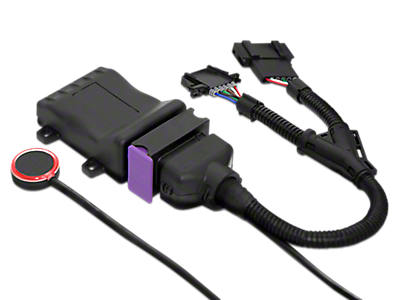
A control module plugs directly into your under-the-hood electrical system, standing right in between the data from your various sensors and the computer. The module intercepts the data before it has a chance to reach the onboard computer. Then, it analyses the information, determines the proper adjustments to the air/fuel ratio, ignition timing and other key functions, and then sends commands to the onboard computer. A control module delivers accurate, immediate tuning for your engine because it is always plugged in and constantly reading and interpreting data from your sensors.
Each control module is custom-programmed to maximize the output and efficiency of your vehicle's specific year, make and model, taking into consideration engine size, transmission type and even your stock tire size. What's more, many control modules come in different power levels, or stages. That way, you can choose the perfect amount of power for your unique driving habits.
Many of the control modules for diesel rigs have optional in-cab performance monitors that display up-to-the-second readings of such critical engine information as turbo boost, engine gas temperature and RPMs. Some even display your 0-60 acceleration and quarter mile time, and give you on-the-fly control of different settings. For the best results, you will want to use a higher grade fuel with more octane, like 91 or higher.
Installing a control module is simple and should not take more than 15 minutes. They have a built-in, heat-shielded wiring harness that plugs directly into your onboard computer, so there's absolutely no soldering, splicing or drilling required. After all the wires are connected, you never have to worry about adjusting the module ever again, unless you would like to return to your factory settings.
A number of well-respected brands make power-packed control modules, including Quadzilla, BD Diesel, Jet, Edge, Venom, Predator by Dr. Performance and Bully Dog.
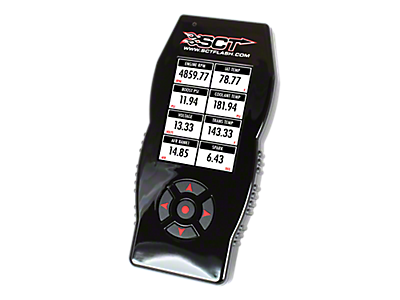
Like control modules, power programmers reconfigure your vehicle's onboard computer to perform at peak levels. But, they work a little differently. Rather than being permanently installed into your electrical system, power programmers are plug-n-play devices.
Before hitting the road, you connect the power programmer to your OBD-II Port, which is handily located right under your dashboard. You will then answer a number of questions about your vehicle, any modifications you have made, and what level of power you want. Based on how you respond to the questions, the power programmer then uploads a new set of operating instructions to your vehicle's computer. The new operating program only has to be uploaded once, so you can pack away your power programmer or experiment with some of the other settings and modes. Best of all, the whole process only takes about 10 minutes, and the only tools you'll need are your own two hands.
The advantage of power programmers is that you have greater control over the tuning of your system. For example, you will be able to recalibrate your onboard computer to any changes in tire size, speed rating or even your rear-end gear ratio. These changes dramatically affect your vehicle's performance, but your computer doesn't know to recalculate unless you use a power programmer to communicate with it. Moreover, many of our power programmers let you tune your engine for regular octane usage instead of the usual 91 or higher fuel grade.
Like control modules, power programmers are made by a number of notable manufacturers, such as Superchips, Hypertech, Edge, Diablo Sport, SCT, Jet, Quadzilla, BD Diesel and Edelbrock.
If you want total control of your vehicle's computer system, don't just reprogram itreplace it. An engine management system (EMS) is a complete substitution for your stock onboard computer, giving you virtually unlimited command over just about ever aspect of your vehicle's control system.
Engine management systems are designed to customize your car, truck or SUV to your exact specifications. For those who know about the inner workings of your entire drive train, only an EMS gives you full control of every minute detail, from your air/fuel ratio and fuel injector control, to idle speed and nitrous (wet or dry) management.
You mount the EMS inside your engine compartment. Once it's secured, you simply unplug the wires from your old computer and plug them into the new one. Those wires sync your EMS with all of your vehicle's sensors, so it has an immediate connection to all the data from every critical part on your automobile. It uses the readings from your sensors to run your engine at its peek level. You can even plug your laptop into the EMS to view performance information and manipulate settings.
EMS systems are a highly specialized accessory, and AEM is your source for this high-tech gear.
Installing a control module or power programmer onto your vehicle should not void your factory warranty. Your rights are protected by the Magnuson Moss Warranty Act. This important law states that a manufacturer cannot void your warranty merely because you install aftermarket parts, unless they can prove that the part itself caused the damage. In other words, if you install a performance exhaust system or a high-flow air filter, and then your automatic windows stop working, they are legally bound to service your windows. The same is true for control modules and power programmers. They do not void your warranty, unless the dealer can prove that the part itself caused the damage.
Keep in mind, though, that installing an engine management system (EMS) will invalidate your manufacturer's warranty.